Investment Casting · Shot Blasting · Sand Blasting — Gurgaon, India

EVERY CASTING HAS
A TEMPERATURE HISTORY.

Rock Mining Smith runs its investment casting, shot blasting and sand blasting lines out of Udyog Vihar, Gurgaon. Every stage below is shown with the actual reading it runs at — degrees, metres per second, or psi — so what you see is what happens on the shop floor.

investment-casting
Lost-Wax
INVESTMENT CASTING
Steel Shot
SURFACE PEENING
Abrasive Air
SAND BLASTING
Dimensional
QUALITY CHECK

Investment Casting Process

Precision Manufacturing for High-Quality Industrial Components

Investment casting, also known as the Lost Wax Casting Process, is one of the most accurate metal casting methods used to manufacture complex and precision-engineered components. The process provides excellent dimensional accuracy, smooth surface finish, and minimal machining requirements.

Rock Mining Smith manufactures premium-quality investment castings for mining, construction, automotive, engineering, railway, and heavy industrial applications using advanced technology and stringent quality control.

Shot Blasting Furnace Process

After heat treatment, cast components undergo the shot blasting process to remove scale, oxidation, rust, and surface impurities. High-speed steel shots clean the casting surface and prepare it for machining, painting, or coating.

Benefits
  • Removes rust and oxidation
  • Improves surface finish
  • Enhances coating adhesion
  • Increases component durability
  • Prepares castings for final inspection

Sand Blasting Furnace Process

Sand blasting is performed after furnace treatment to remove ceramic shell, casting residue, burrs, and contaminants. Abrasive sand produces a clean, smooth, and uniform surface suitable for machining and protective coatings.

Benefits
  • Removes casting residue
  • Creates a smooth surface finish
  • Improves paint adhesion
  • Enhances product appearance
  • Improves corrosion resistance

Applications

Our investment castings are widely used in mining, construction, oil & gas, railway, agriculture, power generation, heavy engineering, automotive, and industrial machinery. Every product is manufactured to meet international quality standards with precision, strength, and reliability.

Process 01 · Thermal

Investment Casting Procedure

Also called lost-wax casting — a wax pattern is built up in ceramic shell, then burned out and replaced with molten metal. Each stage below runs at a specific, controlled temperature.

01

Wax Pattern Injection

Molten wax is injected into a metal die to form an exact replica of the finished part, including shrinkage allowance.

~65°C
wax temp
02

Pattern Assembly (Tree Building)

Individual wax patterns are attached to a central wax sprue, forming a "tree" that lets several parts be shelled and cast together.

~22°C
ambient assembly
03

Ceramic Shell Building

The tree is repeatedly dipped in ceramic slurry and coated with refractory stucco, building up a hard shell over several drying cycles.

~24°C
dip & dry cycle
04

Dewaxing (Flash Autoclave)

The shell is flashed in a steam autoclave under pressure, melting the wax out quickly before the shell can crack from expansion.

~165°C
autoclave steam
05

Shell Firing (Burnout)

The empty shell is fired in a kiln to remove residual wax and moisture, and to develop the strength needed to hold molten metal.

~1000°C
kiln burnout
06

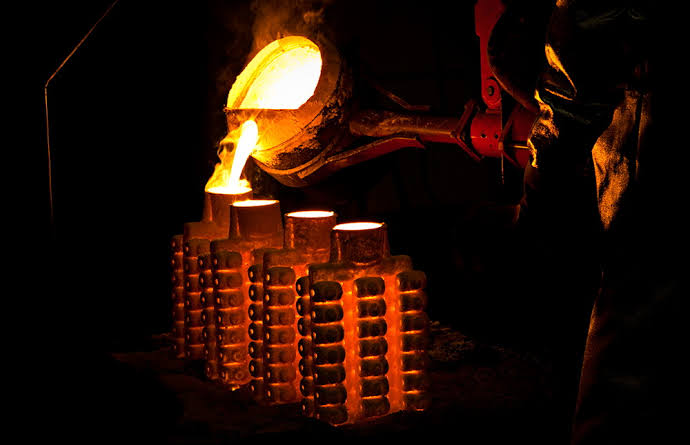
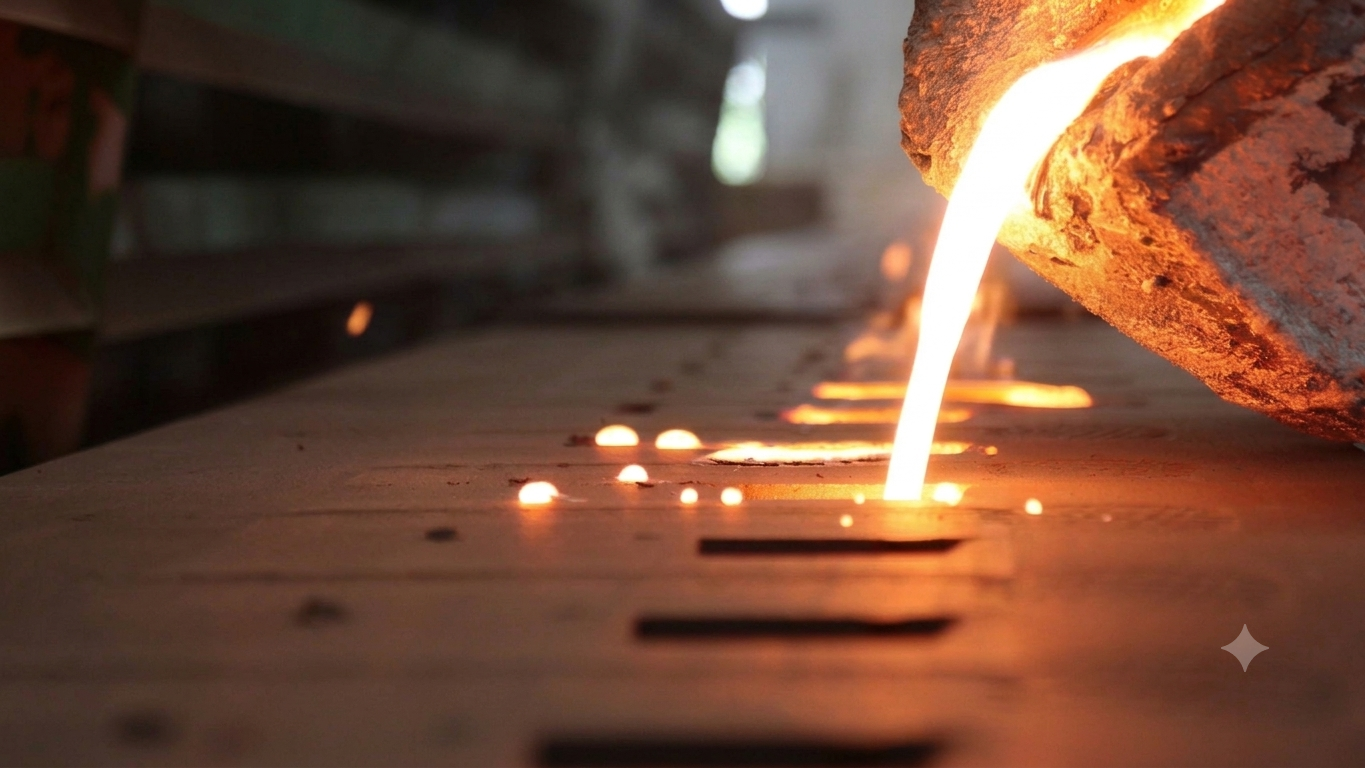
Pouring

Molten alloy is poured into the still-hot shell straight from the furnace, filling every cavity left by the burned-out wax.

~1550°C
molten pour, steel grade
07

Cooling & Shell Knockout

Cast trees cool to room temperature, then the ceramic shell is broken away by vibration and water blasting to expose the metal parts.

~28°C
cooled casting
08

Cut-off, Grinding & Inspection

Parts are cut from the sprue, ground smooth, then checked dimensionally and for internal defects before moving to finishing.

Process 02 · Mechanical

Shot Blasting Furnace-Line Process

Once castings come off the furnace line, steel shot is thrown at the surface at high velocity — stripping scale and sand, and compressing the surface layer for better fatigue life.

01

Casting Intake & Sorting

Castings arrive from the knockout stage still carrying oxide scale and traces of shell sand, and are batched by size for the blast cabinet.

02

Loading — Tumblast / Hanger Cabinet

Parts are loaded into a rotating tumblast barrel or hung on a monorail, depending on geometry, so every face gets even coverage.

03

Steel Shot Blasting

A turbine wheel throws round steel shot at the castings, knocking off scale and sand and leaving a uniform, slightly peened surface.

~65–80 m/s
shot velocity
04

Shot Recovery & Magnetic Separation

Spent shot, dust and broken media fall through a screen deck; a magnetic separator recovers reusable steel shot back into the wheel.

05

Surface & Dimensional Check

Blasted parts are checked for surface finish and residual scale before being passed on to machining or sand blasting for finer work.

investment-casting
Process 03 · Mechanical

Sand Blasting Furnace-Line Process

Where shot blasting is the heavy first pass, sand blasting handles the finer cleaning — removing rust, light scale, and preparing surfaces for coating or paint.

01

Surface Inspection & Masking

Machined faces, threads and datum surfaces that must stay untouched are masked off before the part enters the blast booth.

02

Abrasive Media Selection

Silica sand, aluminium oxide or garnet is chosen based on the base metal and the finish the next process — machining or coating — needs.

03

Compressed-Air Blasting

Media is propelled through a nozzle at controlled air pressure, stripping rust and light scale without gouging the base metal.

~80–100 psi
line air pressure
04

Dust Extraction & Media Reclamation

A cyclone dust collector pulls fines out of the booth while usable media is screened and returned to the hopper for reuse.

05

Final Cleaning & Quality Check

Parts are blown down, wiped free of residual grit, and inspected against the finish spec before packing or coating.

What Runs Through the Shop

Materials & Checks

Carbon & Alloy Steel

General engineering and structural casting grades.

Stainless Grades

Corrosion-resistant castings for valve and pump bodies.

Ductile & Grey Iron

Higher-volume components where iron is the right fit.

Dimensional & Visual Inspection

Every batch checked against drawing before it ships.

https://www.embed-map.com

Rock Mining Smith
90B, Delhi - Jaipur Expy,
Udyog Vihar, Sector 18,
Gurgaon, India 122001
 +91-9818008923    
rockminingsmith@gmail.com